
Moving risks
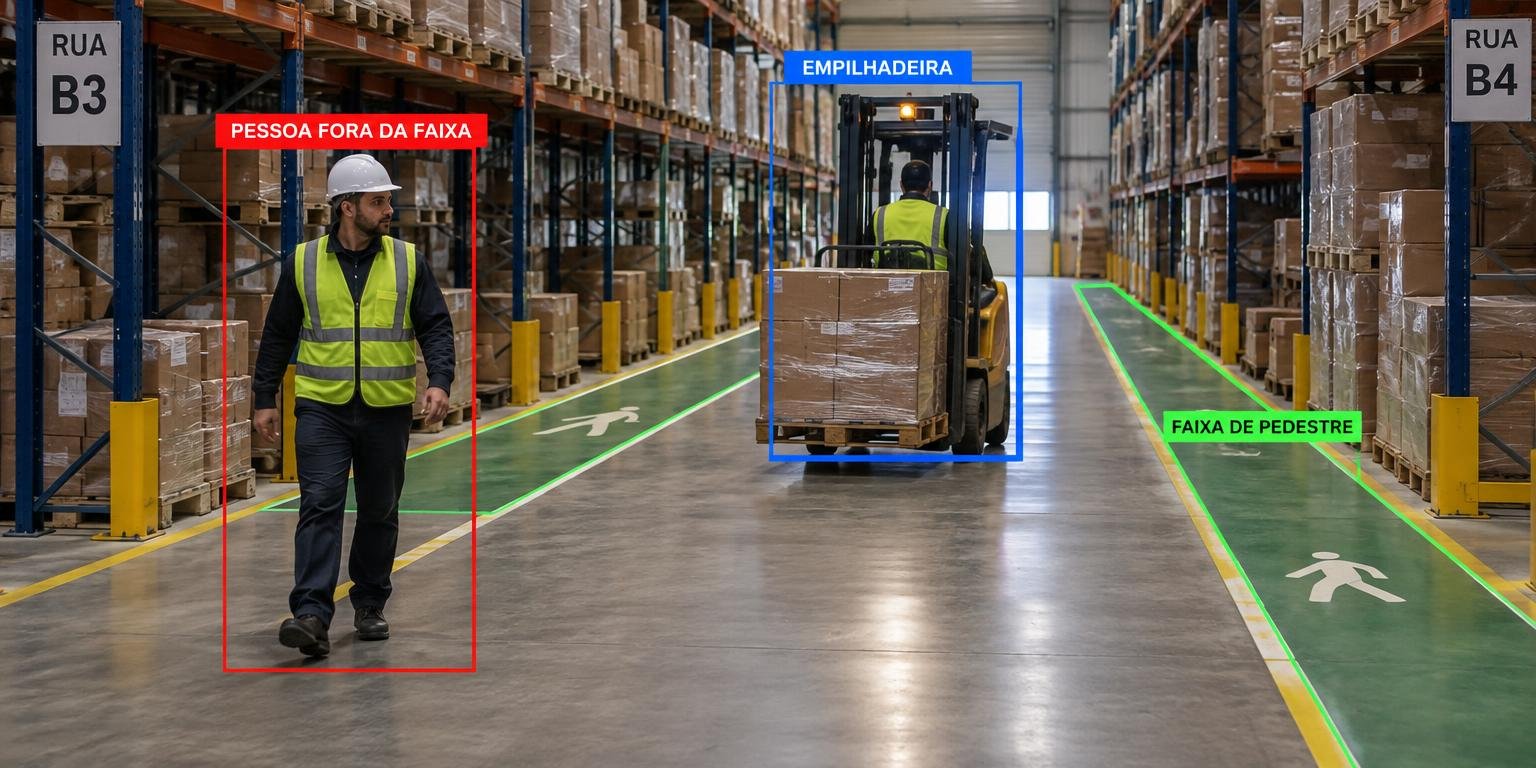
Traffic of pedestrians, forklifts, and cargo in the same space requires constant attention to high-risk zones.
Safety, security, and visibility across every area of industrial operations.
Tell us about your plantWe connect video, artificial intelligence, and industrial systems to provide visibility into PPE usage, occupancy at stations and areas, work shifts, and situations your operation defines as priorities.
Areas, rules, and alerts are defined with the security and operations teams.
Traffic of pedestrians, forklifts, and cargo in the same space requires constant attention to high-risk zones.
Guard tours and manual checks capture the inspection moment, but leave the rest of the shift unmonitored.
Production, safety, and maintenance information does not always connect to events observed on the factory floor.
We collaborate with security and operations teams to define key areas, risks, and rules. Based on this, we configure analytics, integrate events into existing procedures, and validate results under real plant conditions, without replacing mandatory safety controls.
Identify the use of visually recognizable personal protective equipment, such as hard hats, within designated areas.
Track workstation occupancy and presence in zones requiring continuous staffing, with unplanned absence alerts.
Compare dwell time in cafeterias and break areas against operational limits and trigger alerts when exceeded.
Log entry and exit, identify delays, and trigger automated notifications to managers.
Generate alerts for events such as a person outside the crosswalk or movement within equipment areas.
Notify guardians with event snapshots and maintain history for review.
Send events to management, maintenance, or occupational safety systems via REST API and webhooks.
Organize events by area, shift, and type to support process reviews.
Analytics performance depends on camera positioning, lighting, and site conditions, and is verified during the proof of concept.
Alert when a pedestrian is walking outside designated crossings.
Verify hard hat compliance before access.
Flag prolonged absences at stations that require continuous staffing.
Alert when dwell time exceeds the defined threshold for the area.
Log timestamps, flag delays, and automatically notify managers.
Query events by area and time with associated images.
Illustrative examples. Rules and alerts are configured for each operation.
Events can feed management, maintenance, and workplace safety systems, depending on the interfaces available in each environment.
We understand the goals, processes, and existing systems.
We define the solution, integrations, and infrastructure requirements.
We configure, customize, and connect the features planned for the project.
We test the solution in the live environment and guide teams.
We monitor operations according to the contracted scope and identify improvements.
Tell us which risks and routines you want to monitor. We will design the solution with your team.